
Trudeaupia: Free Health Care for Extraterrestrials?
June 10, 2008 by Paul McKeever · 3 Comments
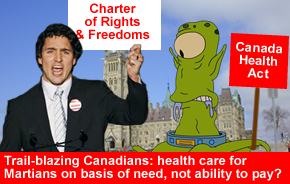 On the National Post’s blog, columnist Jonathan Kay reports that Justin Trudeau – son of the now-deceased former Prime Minister Pierre Elliott Trudeau (a father of Canada’s Canadian Charter of Rights and Freedoms) – shared with a questioner his opinion on whether Canada’s Charter would protect extraterrestrials, were they to (exist and) land in Canada. In a nutshell, he said that the Charter would apply if the alien first became a Canadian citizen. His response betrayed an ignorance of the Charter, given that several of its provisions apply even to those lacking Canadian citizenship. Read more
Inflation, the Gold Standard, and Fractional Reserve Banking
May 28, 2008 by Paul McKeever · 8 Comments
Interested in learning (or about learning more) about money and banking? Read more
With "Property Rights" Advocates Like These, Who Needs Tyrants?
April 15, 2008 by Paul McKeever · 2 Comments
In recent years, a group of land owners (mostly farmers) in Ontario, Canada has – largely under the former leadership of an electrician named Randy Hillier – become a voice deemed by the media to be worthy of news coverage. On the surface, the Ontario Landowners Association appears to be in favour of government ceasing to violate their property rights. Their signs – which can be seen all over the Ontario countryside, posted to farm fences, particularly in Eastern Ontario – read: “This is our land. STOP. BACK OFF GOVERNMENT”.

Former OLA chief Randy Hillier wearing
a tee-shirt version of the sign found
on many farm properties in Ontario.
Approximately a year ago, Hillier resigned from the management of the OLA and used his popularity among members and supporters to win himself the nomination of the Progressive Conservative (PC) party in Ontario. Many advocates of property rights were perplexed by the move, given that the PC party historically (but with the brief exception of the leadership of Mike Harris) has been Ontario’s most substantively socialist/collectivist party. It introduced the Human Rights Code, rent controls, and the provincial income tax; it banned private health insurance and set up a tax-funded government monopoly on health insurance, etc.. Rather than conclude that Hillier has given up on advocating property rights, it would appear more accurate to conclude that Hillier’s expectations are merely naive, and that he believes he can (presumably with some ongoing assistance by the OLA) transform the “red tory” PC party into a party that is in favour of government that defends rather than violates, property rights.
That he is likely to fail in his effort to turn a pig’s ear into a silk purse becomes even more obvious when one considers the decidedly mixed bag of political wants held by members of the OLA. At times, the mutually exclusive nature of these wants has become high-profile. For example, when the OLA clogged the traffic arteries of Toronto’s core at and around the Ontario legislature, the media did live radio interviews with the many people driving their tractors to the event. There were indeed some libertarian-sounding property-rights advocates among those interviewed, but such members were decidedly mixed with farmers that wanted something akin to tax-funded subsidies for failing agricultural ventures, etc. (Interesting aside: the effort to get headlines by creating a traffic jam and storming the legislature grounds with tractors got overshadowed in two ways: 1. a competing farmer association [probably supportive of the governing Liberal party] pulled the exact same stunt one week earlier, and 2. when the OLA did it, a man pulled up in a truck, babbled incoherently, poured gasoline on himself, and lit himself on fire…guess which story got the bigger headline? It makes one wonder how many “Thank-you” and “Job Well Done” cards the man received from the Liberals).
All of which brings us to the news today that the OLA is – loudly, and with a press release – threatening to “clear cut” 100 square kilometers of wooded land in Eastern Ontario. According to today’s pre-fab report by the Canadian Press (you know the sort: printed in newspapers of every stripe; just add a headline, print it in your newspaper, and pretend that you are still a source of news), the threatened clear cutting relates to a law which violates property rights so as to protect endangered species:
If an endangered bird is found on someone’s property, [the OLA’s Jack] MacLaren says their property values plummet and they can no longer use part of the land for farming.
“Ah”, you might infer, “the OLA is objecting to the endangered species legislation, saying that it violates their property rights”. Well, sadly, no. The Canadian Press explains that:
[McLaren] says that’s not fair because the government doesn’t offer to compensate those landowners.
Might I suggest changing the OLA’s sign a bit: “This land is our land. STOP. Back off government...unless you come with gifts of money taken forcibly from other people“.
This is yet another example of people wanting “freedom for me, but not for thee”, and it all results from wanting freedom for the wrong reasons. The rightness of defending ones control over ones own land is properly founded on the necessity of that control if one is to use the land in accordance with ones own rational decisions about its use. In other words: property makes it possible for one to live a rational (hence productive and happy) life. Asking for “compensation” from the government in exchange for the violation of ones own property is not a call for freedom. It is a call to push the costs of tyranny onto someone else’s shoulders. It is not a defence of property: it is a call to tax others and hand the loot over to landowners; it is a call to violate other peoples property; it is a sanctioning of government violations of property; it is a call for the government to protect landowners from the effects of tyranny, by imposing additional tyranny other others.
If the OLA is successful in their bid to loot other Ontarians, one can only hope that they spend a few bucks on a copy of Atlas Shrugged (and that they actually read it), so that they can realize, before it is too late, just how badly they are defeating their stated goal.
Tribalist/Conservative Watch #2
April 7, 2008 by Paul McKeever · Leave a Comment
Today, the Barrie Examiner reported that Ontario’s Progressive Conservative Party leader, John Tory, was in Barrie on Saturday. He made the following comment, among others, which I submit for your interpretation:
The McGuinty government isn’t making it very attractive to do business in Barrie…
This implies that, according to conservative ideology, government should pass laws or spend money in an attempt to encourage persons to open/keep businesses in a given community. In other words: according to conservative ideology, the government should centrally plan the economy. This, incidentally, is one of the reasons why you will hear John Tory use the weasel term “free enterprise” (which simply refers to private businesses operating within a centrally planned economy) but not the term “free market” (which refers to a market that is not centrally planned, but shaped by the production and consumption choices of individuals).
The advocate of a free market complains not that the government has not made things “more attractive” to business, but that the government has not “eliminated legal disincentives” to business.
ADDENDUM:
One might ask: “Well, surely the same can be said about the Liberals, so why aren’t you picking on them?”
My answer is: Ontario liberals are openly socialist/corporativist/collectivist. They’re not trying to fool anyone about their ideology. In contrast, the conservatives – who likewise are socialists/corporativists/collectivists – try to win the support of capitalists and individualists by using weasel words and by condemning the liberals for being opposed to tax or spending cuts. Yet, all the while, its a matter of documented fact that the conservatives have raised, not lowered taxes, and have increased government involvement in non-governmental things (like health care), not decreased it. As a result of this dishonesty and political cross-dressing, the conservatives have achieved three main things:
1. people have been deceived into believing that they are at the “right” end of the political spectrum, even though that is false;
2. the size and existence of the conservatives’ parties have ensured that voters have two choices: socialism/corporatism/collectivism dressed up in red, or socialism/corporatism/collectivism dressed up in blue.
and
3. people have come to associate the word “conservative” with: dishonest, bait-and-switch, say-one-thing-and-do-the-oppositism; with “secret agendas”.
If Ontario voters are going to have the ability to vote for a sizable party that is not socialist/corporativist/collectivist, the the socialist/corporatist/collectivist party that pretends to be a capitalist/individualist party must be exposed as what it really is: pro-socialism, pro-corporatism, pro-collectivism, and willing to falsely claim to be capitalist/individualist in order to ensure that no actual party of capitalism/individualism is believed to be necessary.
Tribalist/Conservative Watch
April 2, 2008 by Paul McKeever · Leave a Comment
As reported by Canadian Press, just the latest bit of tribalist ideology from the leader of the Progressive Conservative Party of Ontario:
Critics say the McGuinty government has done little beyond giving lip service to the issue. Progressive Conservative Leader John Tory said the initiatives so far are just the “bare minimum to look like they’re acting.”
That would create thousands and thousands of jobs and produce hundreds and hundreds of millions in revenue that could be applied to a whole variety of things,” he said. “They’re doing none of that.”
That’s right folks. According to conservatives in Ontario, the purpose of a strong economy is: to raise more revenue for the government to seize and spend on “a whole variety of things”.
Tribalist/Conservative Q&A
Q. Isn’t the improvement of my own standard of living the purpose of improving my own income?
A. Don’t be silly. The purpose of improving your productivity and income is to give the government more money with which to buy your vote.
Q. Don’t I try to earn more partly to secure myself a fund for rainy days?
A. Nope. Taking care of you in bad times is the government’s job.
Q. Don’t I try to earn more so as to pursue my own happiness?
A. How can you think about your own happiness when others are in discomfort?!
All of which self-serving altruism brings to memory this excerpt from Ayn Rand’s “What is Capitalism?” (the first essay in her book Capitalism, the Unknown Ideal):
Now consider the alternative – the tribal society, where all men throw their efforts, values, ambitions, and goals into a tribal pool or common pot, then wait hungrily at its rim, while the leader of a clique of cooks stirs it with a bayonet in one hand and a blank check on all their lives in the other.

…to be continued…and continued…and continued…
Government Employment and Hand-outs
April 2, 2008 by Paul McKeever · 5 Comments
A facebook friend asked me:
What is your view on accepting governmental jobs outside the sphere of what a small state would comprise of, for example worikng as a teacher in highschool or as a nurse or doctor?
On a realted issue: what is your view on using government funded services or accepting subsidies one’s “entitled” to?
I responded as follows:
With respect to your first question:
If not considered carefully, your question might be considered as one that assumes a host of unstated facts. And, if one is not careful, ones answer to your question might wrongly be determined by the unstated assumptions, rather than by the stated facts.
Two unstated assumptions seem likely to be made by a person considering your question:
- that the government is funded in an immoral way (e.g., with income taxes); and/or
- that the government has a monopoly on the services in question (or has set itself up with laws that give it an advantage via coercion).
If you assume either of those while considering your question, you will be more likely to conclude that working for a government as a teacher, nurse, or doctor would be wrong. Note, however, that the real issue there is not “jobs outside the sphere of what a small state would comprise” but: evil government funding, or evil protectionism/monopoly.
To properly answer the question you do ask, therefore, be careful not to make assumptions such as 1 and 2. Instead, assume:
- that the government is not funded immorally (e.g., it is funded voluntarily); and
- that the government has no legislated monopoly or protection with respect to its educational and medical services.
The issue then becomes clear: is it wrong to work for such a government as a teacher, nurse, or doctor? Clearly, the answer is: “no”. If nobody is forced to pay for the government’s educational or medical services, and if everyone is free to compete with the government’s educational and medical services, then there is nothing morally wrong in the government offering such services, and there is nothing morally wrong in accepting employment from the government in respect of those services.
If, instead of just answering the question you actually asked, we assume that the government is funded immorally (e.g., with income taxes), then the issue is not really “jobs outside the sphere of what a small state would comprise”. Rather, if one assumes immoral funding, the issue is: should one accept any form of employment from a government that is funded immorally (e.g., should one accept employment from such a government even in the role of police officer or warden?).
Similarly, if instead of just answering the question you actually asked, we assume that the government has passed laws that give it a monopoly on health care (as is the case in Ontario), then the issue is not “jobs outside the sphere of what a small state would comprise”, per se. Rather, the issue is: should a person accept employment with an employer that holds an immoral monopoly? Consider as an example whether, in that situation, it is moral to accept a government job as a police officer when your job might require you to arrest the owners of private (i.e., illegal) health clinics. Does the fact that policing is inside “the sphere of what a small state would comprise” make it morally right to accept the policing job, but morally wrong to accept a job as a doctor in the government’s health care monopoly?
Finally, consider that not all legislated monopolies are government-owned. That includes doctors, lawyers, trades, etc., each of which has a guild and a monopoly: a non-lawyer cannot do most legal work; a non-member of a college of physicians cannot do most medical work; et cetera. Thus, the issue of whether the employer is a government is a red herring if what you really want to know is the morality of working for an employer that has an immoral and state-imposed monopoly.
In short, it is very important not to confuse the issue raised in your question by making such unstated assumptions. If, on the other hand, your question was mis-stated; if what you really intended to ask was a question not about “jobs outside the sphere of what a small state would comprise”, but about working for an immorally-funded government, or for an immoral monopoly, then you should re-formulate your question.
With respect to your second question:
If you pay taxes, use those tax-funded government services and take every penny the government will give you. Imagine that it is your birthday, and you are visited by the neighbourhood crook, who we’ll call Tony Soprano. Soprano obtained all of his money by stealing it from others, including yourself. Tony hands you a $100 bill and says “happy birthday”. Assuming that he has stolen at least $100.00 from you in the past, is it immoral for you to accept the money? Answer: no. If, on the other hand, Tony has never stolen from you, it would be immoral to accept the money (unless your intention is to return it to the people/person from whom the money was stolen). Unfortunately, it is unlikely in the extreme that you are not a Tony Soprano victim (i.e., a taxpayer) and, accordingly, it is very unlikely that it would be immoral for you to use government services or take government hand-outs.
Regards,
Paul McKeever
John Tory's Bait & Switch for Gullible Right-Wingers
March 28, 2008 by Paul McKeever · Leave a Comment
Realizing that he’s got problems in his own party – those in it who want smaller government and reduced taxes are looking to leave his party – party leader John Tory has resorted to posing as a Harrisite, without actually proposing anything in particular.
In the Toronto Star’s editorial today – laughably titled “Tory Turns to the Right” – the Star reports that Tory yesterday gave a post-budget speech to the Economic Club of Toronto:
Tory’s solutions are right out of the Mike Harris hymnal: Cut taxes and allow “businesses and families to keep more of their own money.” Shrink regulations. And take a hard look at the number of civil servants who are making big salaries and “breathing each other’s exhaust.
Which taxes exactly? Silence.
How much? Silence.
Which civil servants should be canned? Silence.
How much should spending on the civil service be reduced? Silence.
Thankfully, the Toronto Star was keen enough to notice that Tory’s words on tax cuts and spending cuts are of the “Here I sit, broken hearted, paid and dime and only farted” nature:
Tory didn’t help his case by dodging reporters’ questions about what services he would cut to pay for tax breaks. Instead, he criticized the Liberal government for not looking for unspecified “efficiencies” and “waste.” He also suggested McGuinty could have slowed down “other initiatives” to fund tax cuts, although he did not spell out which ones.
Ah yes, “finding efficiencies”, “reducing waste”, “tightening the belt”, yada yada yada. The same schtick he delivered leading up to the election of 2007…and the same one he’ll continue to deliver, because he is actually a defender of Ontario’s health insurance monopoly, a defender of tax-funded government-owned/operated schools, and a defender of Ontario’s various welfare programs. He’s repeatedly said that keeping those programs well-funded takes priority, even if that means raising taxes.
Tory’s real aim is to make it LOOK as though he’s turned hard right so as to shore up support within his party.
He has absolutely no plan to deliver tax cuts or spending cuts of any significant nature or extent. Mark my words. He’s just desperate.
Burn Your PC Membership Card: PCs Give Up Fighting for Tax Cuts
March 27, 2008 by Paul McKeever · 3 Comments
The Ottawa Citizen’s Lee Greenberg today reports that Ontario’s Progressive Conservatives won’t be fighting for tax cuts. Party leader John Tory lacking a seat in the legislature, acting Opposition leader Bob Runciman had this to say:
The reality of the situation is that most of the stakeholders seemed to have rolled over on this, even the ones who were complaining loudly prior to the budget — whether the Canadian Manufacturers (and Exporters), the (Ontario) Chamber of Commerce…
…What’s the point of continuing on this, especially when the people who are most impacted have sort of waved the white flag?
Subtext: the Progressive Conservative party follows the polls, not principles. And, even then, it really only polls interest groups, not individuals: if the Chamber of Commerce doesn’t want tax cuts, but you do, too bad.
Now, for those wondering what to do with their Progressive Conservative membership card, a helpful hint. For those with more flair, here’s another way. (And, please, if you do either, video it and put it on youtube).
P.S.: Freedom Party memberships are $10. Just sign an application and send it in with your $10 and, voila, you’re a member.
A Capitalist's Guide to Ontario's Budget
March 26, 2008 by Paul McKeever · 4 Comments
REVENUES (Billions)
Income/Property Taxes:
- Personal Income Tax $25.2
- Corporations Tax: $12.3
- Employer Health Tax: $4.8
- Ontario Health Premium: $2.8
- TOTAL: $45.1
Retail Sales Tax (8%): $17.2
Gasoline and Fuel Taxes: $3.1
Other Taxes: $3.5
KEY EXPENSES (Billions):
Government Health Insurance Monopoly $40.4
Tax-funded, government-owned/operated schools: $13.1
Post-secondary education/training: $6.2
Welfare of various sorts: $11.8
“Other Programs”: $11.9
…oh yeah, we almost forgot “Justice”: $3.7
ANALYSIS
It doesn’t take a genius to see that all but about $3.7B of the Ontario budget is spent on wealth redistribution schemes (and that’s all they are: it’s not as though health care or education services would disappear were the government to allow people to pay for them directly from the service providers).
Key considerations: notice the total of revenue that is taken in the form of income taxes ($45.1B). Note that income taxes – unlike retail sales taxes – can be imposed with progressive rates (i.e., with an income tax, the rate can be made to increase with the person’s income). Finally, note that health and post-secondary education are funded by an amount almost equal to the total of all income taxes.
Now ask yourself two questions:
1. Should I be free to purchase whichever health insurance plan suits my wants and budget?
2. Should I be forced to pay for my neighbour’s child’s Bachelor of Arts degree in sociology (minor in Soviet film studies)?
If your answers to these questions are 1. Yes, and 2. No, then it should be obvious to you that Ontario could eliminate income taxes without running a deficit…thus joining Texas, Florida, Alaska, Nevada and 3 other U.S. states that do not tax income.
The Conservatives' Disingenuous Calls For Tax Cuts
March 25, 2008 by Paul McKeever · 1 Comment
A three word phrase best describes the words of Canadian federal Finance Minister Jim Flaherty, and those of Ontario provincial Progressive Conservative Party leader John Tory, concerning the absence of tax cuts in Ontario’s 2008 budget (released today): Blah blah blah. To say more would be a waste of oxygen, for the simple reason that: neither man means what he has said.
Consider, as exhibit A, today’s Toronto Star editorial, which provided some criticism utterly lacking in papers that boost the federal Tories (notably, today, the National Post and the various SunMedia papers):
Flaherty was free with his advice on the revenue side of the ledger – cut corporate taxes – but not at all forthcoming on how to make up for the lost revenue, which would run in the billions of dollars.
At first, Flaherty retreated to the supply-side mantra that “tax cuts pay for themselves.” When a reporter suggested his recommended tax cuts would lead to lower revenues, Flaherty said: “Of course, that’s not so.” He predicted revenues would rise as the rates were cut.
But in response to a more direct question about where he would reduce spending to offset the tax cuts and keep the budget balanced, Flaherty simply ducked: “I’m not going to substitute my opinion for his (McGuinty’s) opinion,” he said. “That’s why (he’s) premier.”
When a government with a more-or-less balanced budget cuts taxes but does not cut spending, it runs a deficit (i.e., it adds to the debt), which is just another way of saying that it doesn’t cut taxes at all. Instead, it merely shifts them onto the shoulders of future taxpayers. To advocate tax cuts without also advocating spending cuts is tantamount to demanding not a tax cut, but a tax delay (at the cost of increased borrowing).
Even more compelling evidence of the disingenuousness of conservatives’ calls for tax cuts are the words of Mr. Tory. In response to the budget today, he gave a four-page speech in which he concluded, in part:
Ontario has all the right stuff to be on top, to be a leader again. All that’s lacking is a government which gets it. A Premier who understands that you need a strong private sector job creation to pay for public services. (emphasis added)
This isn’t a comment taken out of context. Tory has gone on the record again, and again, and again, making it clear that maintaining Ontario’s “social programs” – i.e., the big three: government monopoly on health care (which represents 46% of program spending), tax-funded government-owned schools, and welfare – is his top priority. Using the socialist conservatives’ favourite weasel-words, “free enterprise” (words carefully chosen not to imply “free markets”), Tory has also explained on TV Ontario’s “The Agenda” program, and elsewhere, that his philosophy – and that of the Progressive Conservative Party – is that the purpose of “free enterprise” is to pay for government’s social programs. Well, look: if his first priority is to preserve spending levels, he cannot possibly want a tax cut. This is just posturing.
If there be any doubt left in your mind, consider this bit of hypocrisy: Tory is on the record as refusing to promise not to raise taxes, especially where raising taxes is necessary to preserve social programs (see, for example, the same episode of “The Agenda”, in which he made these remarks).
None of this has stopped Tory from exhuming this old nut:
…the Liberals are “locked in a tax-and-spend” spiral.
Tory neglected to add that he really has no objection of substance to said spiral.
All of this begs the exhumation of yet another nugget. All together now: “Liberal, Tory, same old story”.